
Calpe has a long coastline, but choosing between the best beaches in Calpe isn’t about finding a complete list of every beach and cove. It’s knowing which one will suit the day you actually have planned.
A family carrying an umbrella, cool box and inflatable wants something very different from somebody arriving with a snorkel and a pair of water shoes. The beach closest to your accommodation isn’t always the best choice either.
Arenal Bol is the most practical option near the town centre. La Fossa is better for a full family day. Cantal Roig suits younger children when it isn’t too busy. El Racó is the pick for snorkelling.
If I’m choosing between Arenal Bol and La Fossa for no particular reason, I lean towards Arenal Bol. It’s the shorter walk back to the town centre afterwards rather than the longer stretch along the seafront from La Fossa.
Calpe doesn’t have one beach that beats every other beach. It has several good beaches that suit different people.
The Best Beaches in Calpe at a Glance
| Beach | Best for | What to know |
|---|---|---|
| Arenal Bol | First time visitors and staying near the centre | Long sandy beach with easy access to town |
| La Fossa | Families planning a full beach day | Sand, restaurants, shops and a long promenade |
| Cantal Roig | Younger children and shorter visits | Small, sheltered and close to the fishing port |
| El Racó | Snorkelling and clearer water | Pebbles rather than sand, at the foot of the Peñón |
| Cala Morelló | A quick swim near Baños de la Reina | Small urban cove with limited space |
| Cala Calalga | A quieter edge of La Fossa | Sand, pebbles and natural seagrass |
| Cala del Mallorquí | A small rocky cove | Limited space and stepped access |
| Les Bassetes | Snorkelling and a coastal walk | Rocky swimming spot beside the marina |
Arenal Bol: The Best All-Round Beach

Arenal Bol is the beach worth recommending to most first-time visitors. It runs beside the town centre, with fine sand, generally calm water and a promenade lined with cafés, restaurants and shops.
Its main advantage is convenience. You can walk there from much of central Calpe without planning the day around the car, and food, drinks and toilets are close by, useful when somebody forgets sunscreen, a child needs the toilet, or half the family wants lunch while the other half wants to keep swimming. The beach also feels open, with a long stretch of sand and a broad view across the bay towards the Peñón de Ifach.
Good for first-time visitors, people staying near the centre, families who want sand and nearby facilities, anyone relying on walking or local transport, a beach visit combined with lunch or the old town, and visitors who don’t want a small rocky cove.
The downside is obvious. It becomes busy in summer, and parking close to the sand can be difficult once the morning is underway. Arriving before the beach fills is the better plan than treating this as a quiet escape. It’s a popular town beach and always will be.
Accessibility: Arenal Bol has one of Calpe’s main adapted beach points. Seasonal services can include assisted bathing and amphibious equipment. Current dates, hours and booking arrangements should be checked before travelling.
La Fossa: The Best Beach for a Full Family Day

La Fossa, also called Levante, sits on the northern side of the Peñón de Ifach. It’s a long urban beach with fine sand, generally calm water and a promenade filled with restaurants, cafés, ice cream shops and other businesses.
For a family planning to stay from morning until late afternoon, La Fossa is difficult to beat. There’s enough close by that you don’t need to carry everything from home. You can stop for lunch, buy drinks or move into the shade without leaving the area. The beach is also much easier with children than the smaller coves. There’s proper sand for toys, more room to spread out and no rocky entry to negotiate.
Good for when the children want a traditional sandy beach, you plan to stay for several hours, restaurants and shops matter, you’re staying around La Fossa, you prefer a long, flat promenade, or you don’t mind a busy holiday atmosphere.
La Fossa can feel very built up during high season. That doesn’t make it a bad beach. It means choosing it for convenience rather than isolation.
Accessibility: La Fossa has Calpe’s other principal adapted beach point. Assisted bathing services are usually available during the summer season, although current operating details should be confirmed before visiting.
Cantal Roig: The Best Small Beach for Younger Children
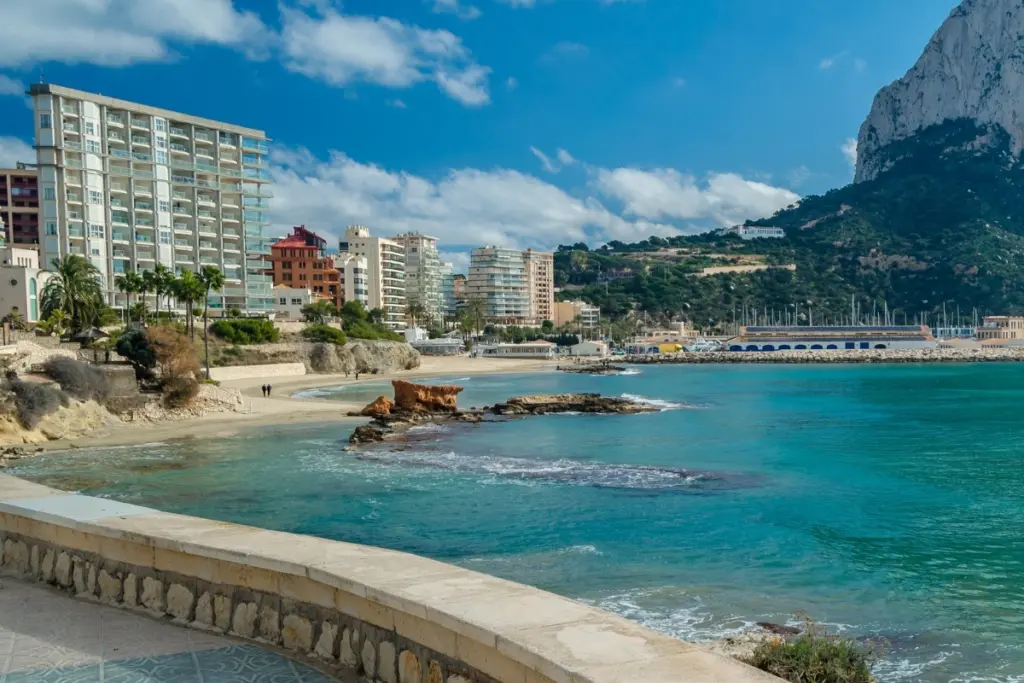
Cantal Roig is a small sandy beach beside Calpe’s fishing port and close to the Peñón de Ifach. The water often feels sheltered, the sand is easy for children and there are restaurants close to the port. It also stays shallow for a good stretch further out than most Calpe beaches, worth knowing if you’ve got children who aren’t confident swimmers yet.
The smaller size is both its strength and its weakness. There’s no long walk from one end to the other, useful with younger children, and the port gives them something to watch when fishing boats are moving in and out.
The problem is space. Cantal Roig can feel crowded with far fewer people than Arenal Bol or La Fossa, and once families have set up umbrellas, towels and toys, there may not be much open sand left.
Good for a shorter morning visit, particularly with young children, though not as the only beach for a full week. It works best when you arrive before it fills.
One thing I want to mention is the water is shallow for a bit further, better for children.
El Racó: The Best Beach in Calpe for Snorkelling
El Racó sits at the foot of the Peñón de Ifach, behind the fishing port. It’s a small pebble cove rather than a sandy beach. The water is often calm in settled conditions, and the cove is known for snorkelling and diving.
Calpe’s underwater trail is installed here during high season, marked with buoys and information panels, and the Princesa de Asturias coastal path begins nearby.
This is genuinely one of my favourite spots for a swim in Calpe when the sea is calm. The water often appears clearer than it does over sand because there’s less fine material being disturbed underfoot, and swimming close to the rocks gives you more to see below the surface.
Best for snorkelling, confident swimmers, a quick swim rather than a full beach day, combining the water with the coastal path, people who prefer pebbles to sand, and visitors carrying very little equipment.
Water shoes make a big difference. The stones become hot, and getting into the sea can feel awkward if you’re not used to walking over rounded pebbles. A thicker towel or mat is worth bringing for anything longer than a quick swim.
It’s not the first choice for toddlers, pushchairs or a family carrying chairs, toys and a large cool box.
Cala Morelló: Best for a Quick Swim Near Baños de la Reina
Cala Morelló is a small sandy cove on the Infanta Elena promenade, close to the Baños de la Reina Roman site. Its strength is the location rather than the amount of space. You can combine a walk along the promenade, a look at the Roman remains and a swim without committing to a full day on one of the main beaches.
It’s not a sensible choice as a main beach destination in August. It’s small and can feel full with relatively few people. For a quick morning or evening swim, though, it makes real sense.
A word of caution about Baños de la Reina: don’t treat the Roman fish farm as a normal swimming pool. The rocks can be slippery and sharp, and sea conditions still matter. Cala Morelló is the easier choice when somebody in your group isn’t confident around rock.
Cala Calalga: Best When La Fossa Feels Too Busy
Cala Calalga lies at the northern end of La Fossa. You reach it from the end of the promenade, where the broad sandy beach gives way to a smaller cove beside Calalga Park. The shore is a mixture of sand, pebbles and natural seagrass.
This isn’t a secret beach, but it can feel calmer than the busiest parts of La Fossa, especially outside the main summer hours. The trade-off is a less uniform shoreline. Expect pebbles, plant material and a less convenient entry than on the main beach.
Natural seagrass doesn’t automatically mean the water is dirty. It’s part of the local marine environment, even when it doesn’t look as tidy as freshly raked sand.
Good for a quieter swim near La Fossa, less so when taking small children who want easy sand and the simplest water entry.
Cala del Mallorquí: Best as Part of a Coastal Walk
Cala del Mallorquí sits between Calalga and Les Bassetes. It’s reached by steps from the Voramar Calalga coastal path and consists mainly of pebbles and rocky platform.
This is the type of cove that looks appealing when almost empty and far less useful when several groups have already taken the limited space. Worth visiting as part of the walk, carrying water shoes, a towel and little else, rather than hauling chairs, a large umbrella, a cool box and children’s beach equipment down to it.
It suits snorkellers, couples, confident swimmers and people already walking the coastal path. It doesn’t suit anyone needing easy access, plenty of sand or full beach facilities.
Les Bassetes: Best for Snorkelling Beside the Marina
Les Bassetes is a small rocky cove beside the marina at the northern edge of Calpe. It’s better treated as a swimming and snorkelling stop than a conventional beach day. You’re not getting a broad stretch of sand for children to play on, you’re getting rock, water access, marine activity and a different view back towards the Peñón.
The Voramar route between Calalga and Les Bassetes also makes it possible to combine several coves in one coastal walk. Good for a swim or snorkel while exploring the northern coastline, not for when the family wants several hours on soft sand.
Best Beach in Calpe for Families
For most families, the real choice is between La Fossa, Arenal Bol and Cantal Roig, covered above.
Taking young children to a rocky cove simply because it looks quieter in photographs rarely pays off. Quiet is useful, but easy entry, toilets, food and enough sand to play on are usually more useful still.
Which Calpe Beach Has the Clearest Water
Water clarity changes with wind, waves, recent rain and the number of people swimming. No beach has perfectly clear water every day.
In settled conditions, the rocky and pebble coves often appear clearer than the large sandy beaches because less fine sand is being disturbed. El Racó is the strongest choice for snorkelling, with Les Bassetes and Cala del Mallorquí also good when the sea is calm, though both are less practical as general beach destinations.
Always check the beach flag and the actual sea conditions before entering. A cove that looked calm yesterday may behave very differently today.
Closest Beach to Calpe Town Centre
Arenal Bol is the practical town beach. It runs beside central Calpe and is within walking distance of many apartments, hotels, shops and restaurants.
Cala Morelló is also close, but it’s too small to replace Arenal Bol for most full beach days. La Fossa is on the other side of the Peñón, still part of Calpe’s urban coastline, but not the beach to describe as closest to the main town centre.
Parking Near Calpe’s Beaches
Parking is often the least enjoyable part of a summer beach day. The closer you try to park to Arenal Bol or La Fossa after mid-morning, the harder the search usually becomes.
Don’t plan the day around finding a space directly behind the sand. Arriving early and accepting a short walk works better, along with checking the restrictions on the exact street where you park. Around Cantal Roig and El Racó, you’re also competing with visitors to the Peñón, fishing port and nearby restaurants.
Never leave bags, phones or other valuables visible inside the car.
Are Dogs Allowed on Calpe’s Main Beaches
No. Dogs aren’t allowed on Arenal Bol, La Fossa or the other main bathing beaches, regardless of the time of day or how quiet it looks.
Calpe has a dedicated dog beach instead, Cala Les Urques, and that’s where to go if you’re bringing one along.
Final Verdict
The best beach in Calpe depends on what you want from the day.
Choose Arenal Bol for the most practical beach near the centre. Choose La Fossa for a full family day with restaurants and facilities nearby. Choose Cantal Roig for younger children and a shorter visit. Choose El Racó for snorkelling. Choose the northern coves when trading sand and convenience for rock, clearer water and fewer facilities suits the day better.
The simple rule: don’t choose a beach because somebody called it the prettiest. Choose the one that makes the day easier.
