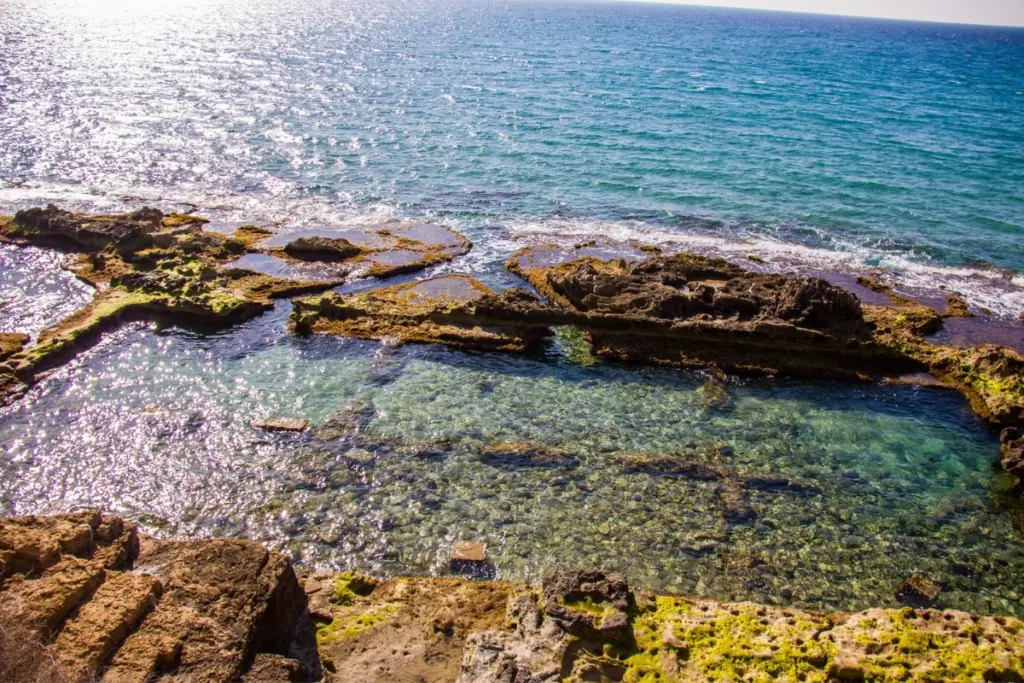
Baños de la Reina in Calpe looks simple from the promenade: a group of rectangular pools cut into the rocks beside the sea. It’s easy to stop, take a photograph and continue walking without realising what lies behind them.
The pools are only the most obvious remains. The ground beside the coast once formed part of a much larger Roman site, and understanding that changes what you notice when you walk past it.
Baños de la Reina becomes far more interesting once you stop looking only at the water. To understand the place properly, you need to see how the pools and the remains on land belonged together.

Baños de la Reina Is More Than the Rock Pools
Most people know Baños de la Reina as the rectangular pools cut into the rocks beside the sea. They’re the most visible part of the site, but they belonged to a much larger Roman settlement.
Around 1,800 years ago, this stretch of coast contained homes, work areas, private bathing rooms and a large villa decorated with marble and mosaics. Only part of the site has been excavated, and more of Roman Calpe still lies beneath the surrounding ground.
The sea pools were probably used to keep live fish close to the settlement. A large tank was cut directly into the coastal rock and divided into six connected sections, with channels allowing seawater to move through them.
There were genuine Roman baths here as well, but they weren’t the pools people now swim in. The Muntanyeta complex included cold, warm and hot rooms, with heated air moving beneath the floors and through the walls.
The name adds to the confusion. A local legend claimed that a Moorish queen used the pools as her private bathing place, which is how the wider archaeological site became known as Baños de la Reina.
That distinction matters. Seen only as an unusual swimming spot, the low walls and foundations on the landward side can look unimpressive. Once you know the pools, baths, homes and work areas belonged to the same Roman settlement, the remains begin to make far more sense.
What You Can See as You Walk Along the Coast

The remains are spread between the promenade and the rocks by the sea, not gathered into one complete Roman complex. That makes it easy to miss how the different parts fit together.
On the landward side, low walls and foundations mark sections of the villa and bathing complex. From ground level, some are difficult to read until you imagine the rooms and heated spaces that once stood there.
Closer to the water, the rectangular fish pools are much clearer. They were cut directly into the rock and connected to the sea by narrow channels.
Look back towards the land after seeing the pools. Most people focus on the water and miss the remains behind them, even though both belonged to the same Roman settlement.
Why Some Visitors Leave Underwhelmed
Baños de la Reina doesn’t immediately look like a major Roman site. There are no standing buildings, tall columns or complete rooms, and the modern promenade makes the different areas feel more separated than they once were.
The sea pools are easy to recognise, but the larger settlement takes more effort to understand. A quick glance at the foundations behind the coast may leave you wondering what you were supposed to see.
Expectations make the biggest difference. Come looking for a dramatic ruin and the visit may feel disappointing. Come knowing that you’re seeing the remains of a Roman villa, heated baths, homes and fish tanks built along the same coastline, and the low walls begin to mean more.
The site rewards context more than time. You could spend twenty minutes there and understand it well, or walk past slowly for an hour without grasping what the scattered remains once formed.
That’s why Baños de la Reina is easy to underestimate. The archaeology is important, but it doesn’t explain itself unless you stop, read about it and look beyond the pools beside the sea.
How to Visit It

Visit Baños de la Reina as part of the walk between Arenal-Bol and Cantal Roig rather than making a separate journey just for the ruins. It’s a lovely stretch of promenade on its own merits, along the coast with the sea beside you the whole way, and the site fits naturally into it without needing a special trip. Twenty to thirty minutes is enough unless you stop for a swim.
Go when the sea is calm if you want a clear view of the pools and channels cut into the rock. Strong waves can hide some of the detail and make the rocks around the water far less inviting.
Shoes with some grip are useful if you plan to step onto the rocky section. The surface can be uneven and slippery near the water, so treat it with more care than an ordinary paved viewpoint.
Read a little about the site before arriving, or use the information boards when available. The remains are much easier to understand once you know which parts belonged to the villa, baths and fish pools.
Late afternoon is a good time for the walk, especially in summer. You can see the site, continue towards Cantal Roig and the port, then stay nearby for a drink or dinner.
Final Thoughts
Baños de la Reina is worth seeing, but it helps to arrive with the right expectations. The rock pools are the easiest part to recognise, while the low walls behind them need more explanation.
Stop here while walking between Arenal-Bol and Cantal Roig rather than planning a separate trip around it. Twenty or thirty minutes is enough to see the pools, read about the Roman settlement and understand how the different remains connect.
For me, Baños de la Reina is a must-see. It’s one of the clearest reminders that this small coastal town has a history stretching far beyond its beaches, apartment buildings and tourism.
Understanding that history changes the visit. What first looks like a few pools cut into the rocks becomes part of a much larger Roman settlement built beside the sea.


