
The Paseo Princesa de Asturias in Calpe is a short coastal walk beneath the Peñón de Ifach. It begins beside Cala El Racó, just beyond the fishing port, and takes around half an hour there and back.
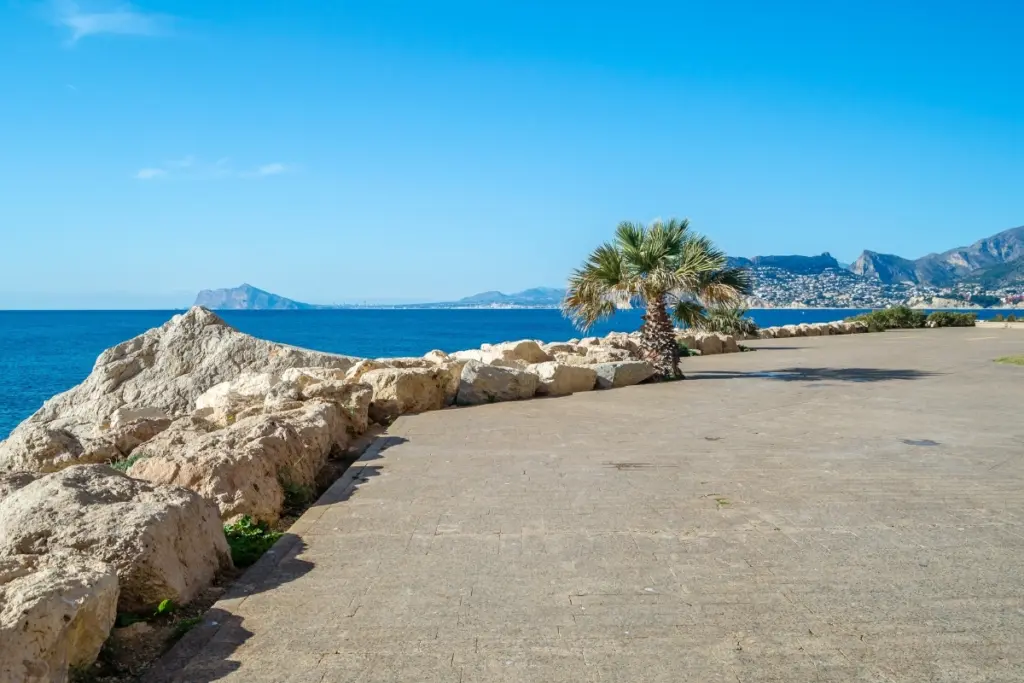
The broad, flat path runs between the Mediterranean and the base of Calpe’s enormous rock. The setting is the reason to come, rather than anything waiting at the end.
This walk gives you a view of the Peñón that the beaches can’t. Once you leave Cala El Racó behind, you quickly understand why.
I’ve done this walk many times over the years, and it’s stayed one of my favourites, a genuinely pleasant, picturesque little stretch, and a great one if you’ve got a small dog like I have. It never feels like a chore, even on a repeat visit.

The Peñón Feels Bigger From Below
From Calpe’s beaches, the Peñón dominates the skyline. From this path, it feels like a wall rising directly beside you. The cliff takes up most of the view on one side, while the Mediterranean opens out on the other.
The port begins to fall behind as you continue, giving you a clearer view back towards the harbour, Cantal Roig and the coastline beyond. Fishing boats, apartment buildings and restaurant terraces quickly look smaller beneath the rock.
This is where you get the best sense of the Peñón’s scale without climbing it. The summit route shows you Calpe from above, but this walk lets you see how abruptly the rock rises from the coast.
The walk is short, but having the cliff beside you and open water on the other side gives it a setting you don’t get elsewhere in Calpe.
The Walk Ends Before You Expect

The promenade is shorter than it first appears. It takes around fifteen minutes each way, and there’s no long coastal route continuing beyond the end.
You follow the same broad path beneath the Peñón until it reaches the area near the heliport. There’s no café, monument or dramatic final viewpoint waiting there. The walk simply stops, leaving you to turn around and see the coastline again from the opposite direction.
That catches some people out, especially when the setting makes the path feel like the beginning of a much longer route. The short length isn’t really a weakness, though. It makes the walk easy to include before lunch, after visiting the port or alongside time at Cala El Racó.
The return follows exactly the same path, although the view changes. On the way back, the port, Cantal Roig and Calpe’s coastline gradually open in front of you instead of falling behind.
The Path Came From the Port
The promenade looks as though it has always followed the base of the Peñón, but this side of the coastline was heavily altered during the construction of Calpe’s fishing port.
In 1957, part of the area beneath the south face was dynamited as work on the harbour moved forward. The path now crosses land shaped by that project rather than an untouched strip of natural coast.
The ecological promenade opened in July 1998. Natural stone was used for the walkway, with planted areas, palm trees and places to stop along the existing breakwaters. The wider landscaped area covers more than 30,000 square metres and stretches for almost a kilometre beneath the rock.
Knowing that changes the walk. What now feels like a quiet route between the cliff and sea partly exists because harbour construction reshaped this side of the Peñón decades earlier.
The promenade later gave people access to that coastline again. Look back along the path and the fishing port remains clearly visible, showing how closely the harbour and walkway are connected.
Cala El Racó Is Part of the Experience
Cala El Racó marks the beginning of the promenade, but it’s worth more than a quick glance on the way past. The cove sits directly beneath the Peñón, with the fishing port on one side and the walking path continuing around the rock on the other.
This is a pebble cove rather than a sandy beach. The water is often clear when the sea is calm, making it a good place for a short swim or snorkel before or after the walk.
A marked underwater route also runs through the cove, with information about the marine plants and animals found around the rocks. You don’t need to follow the whole route to enjoy the water, but it gives snorkellers something more to look for than an ordinary swim beside the shore.
The cove can become busy in summer, and the pebbles are less comfortable than sand when you want to stay for several hours. Water shoes make getting in and out easier, particularly where the stones continue beneath the surface.
Include Cala El Racó for the setting rather than plan an entire beach day around it. The Peñón rising behind the water, the boats nearby and the start of the promenade make the cove feel closely tied to this part of Calpe.
How to Visit It
Combine the promenade with Cala El Racó and the port rather than making a separate trip just for the walk. Everything is close together, so one parking spot is usually enough for the whole area.
Allow around thirty minutes for the promenade itself. Add more time when you want to swim at Cala El Racó, stop around Cantal Roig or watch the fishing boats return later in the day. There’s a small beach club right there too, Satori Beach Calpe, worth knowing about if you fancy a decent drink once you’re done rather than heading straight back into town.
The path is flat and suitable for families, pushchairs, dogs on a lead and anyone who wants to see the Peñón without taking on the summit route. Benches along the way give you somewhere to pause, although there’s little shade once you leave the cove.
In summer, walk in the morning or later in the afternoon. The short distance makes the heat manageable, but the rock and paving can feel harsh around midday.
Starting at the port, continuing past Cala El Racó and then walking beneath the Peñón is the order I’d pick. That way the harbour gradually falls behind while the cliff and open sea take over the view.
Final Thoughts
For me, the Paseo Princesa de Asturias is worth walking because of where it puts you. The Mediterranean opens on one side while the south face of the Peñón rises directly beside you.
There’s no famous viewpoint waiting at the end, and the walk doesn’t need one. The experience is being beneath the rock, watching the fishing port recede behind you and seeing Calpe’s coastline from a completely different angle.
It’s a simple walk, but there’s nowhere else in Calpe where the Peñón feels quite as close.


