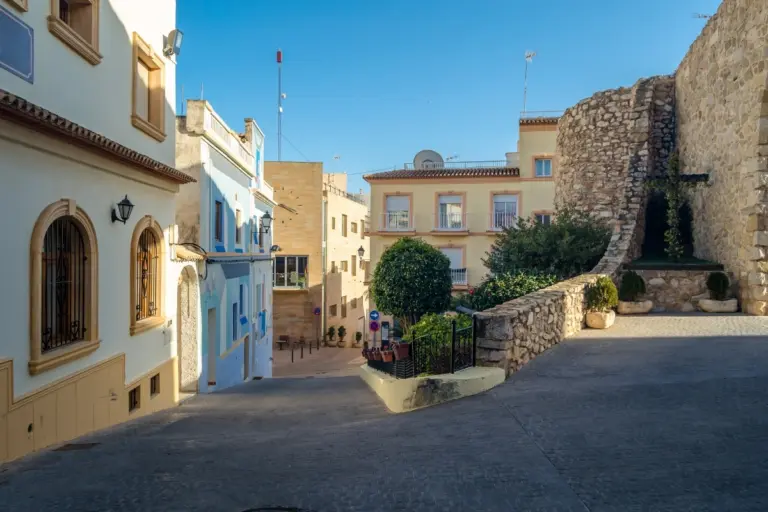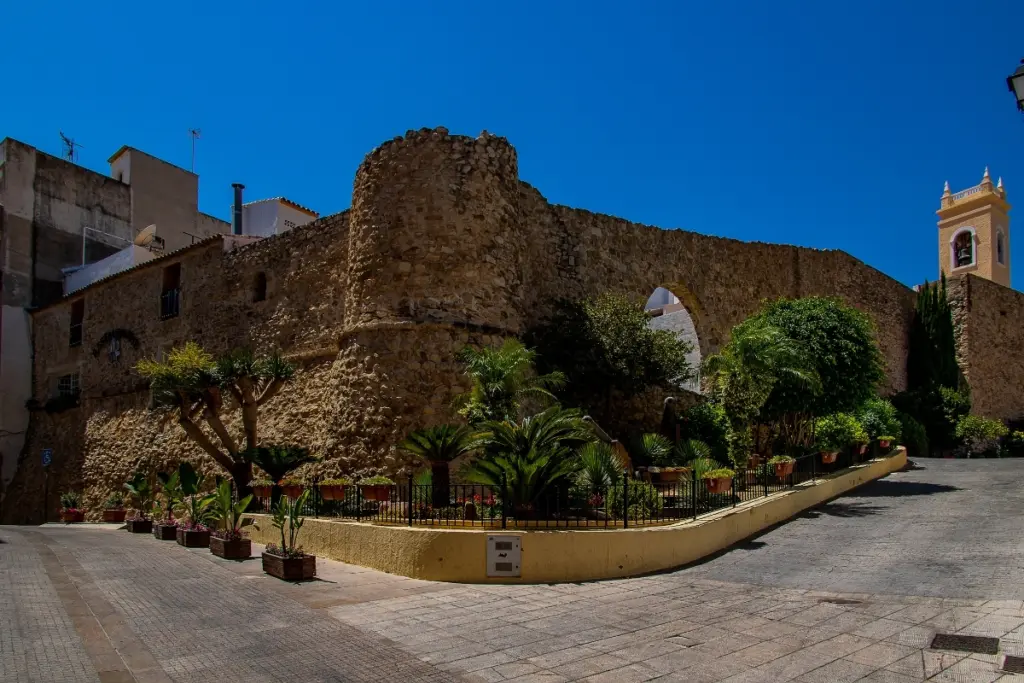
Calpe’s old town once stood behind defensive walls.
The Torreó de la Peça is one of the main surviving structures from Calpe’s former fortified enclosure. It stands beside the old church, surrounded by streets that now give little sense of the attacks, repairs and rebuilding that shaped the area.
Pirates repeatedly targeted Calpe because of its position on the coast. The town strengthened its defences over several centuries, but one raid still ended with almost the entire population taken captive.
The tower and remaining wall reveal a part of Calpe that’s easy to miss when most visitors know the town for its beaches, promenades and views of the Peñón.
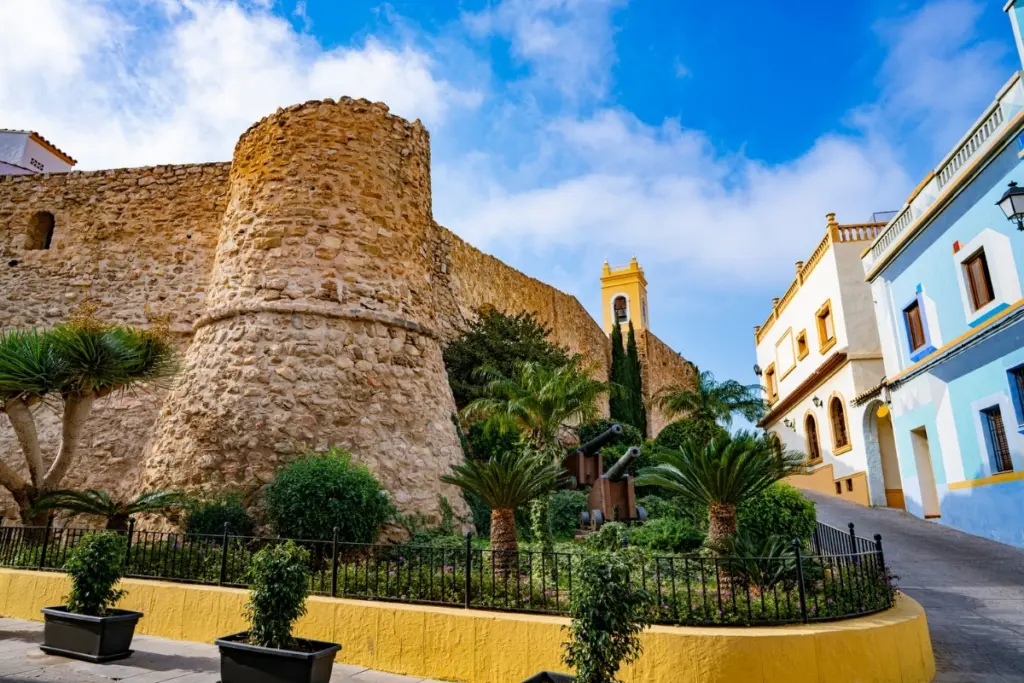
Torreó de la Peça at a Glance
| Detail | What to know |
|---|---|
| Location | Calpe Old Town |
| Origin | Part of Calpe’s former defensive enclosure |
| Original purpose | Defensive bastion |
| Name | Linked to an artillery piece once kept in a nearby fortification |
| What survives | The tower and sections of the former wall |
| Nearby | Two 18th century English cannons, recovered from Calpe’s old port |
| Current use | Museo del Coleccionismo |
| Best combined with | The old church, Forat a la Mar and the surrounding old town |
Calpe Was Once a Walled Town
Modern Calpe spreads along the coast and far beyond the historic centre. The original settlement was much smaller.
Between the 13th and 14th centuries, the community was enclosed by walls designed to protect residents from attacks. Entry was controlled through a gateway known as El Portalet.
That defensive position helps explain why the historic centre developed away from the open shoreline. The Mediterranean brought fishing and trade, but it also left coastal settlements exposed. Pirate raids remained a serious threat, and during the 16th century Charles V ordered Calpe’s walls to be repaired.
The old town now feels open and decorative, with white houses, murals and small plazas. I still find it strange to stand in the middle of it and remember these same streets were built around defence, not decoration.
The Attacks That Changed Calpe’s Defences
The most damaging recorded raid took place in 1637.
Berber pirates reached Calpe without being detected and climbed the walls using ladders while the guards slept. Almost the entire population was taken captive. The walls were meant to protect everyone living inside them, and on that occasion they failed completely.
Another major attack followed on 22 October 1744. That raid is still marked today. It’s the origin of Calpe’s Santíssim Crist de la Suor patronal festivities, a separate tradition from the August Virgen de las Nieves fiestas. Afterwards, a new fortification project began and a second wall was built around the old outer quarter and the original citadel.
The settlement continued to grow, but its walls still controlled how people entered and moved through the town.
Why It’s Called Torreó de la Peça
The name comes from a peça, meaning an artillery piece.
A bastion beside the tower, roughly 17 metres long and 10 metres high, once held the weapon used as part of Calpe’s defences. That bastion stood until 1947, when the council had it demolished, since by then it was blocking the route between what’s now Plaza de Salamanca and Calle Santísimo Cristo. The tower itself is what turned up once the demolition was done, and it’s what still stands today.
The artillery connection is easy to miss now. The tower stands beside pedestrian streets and painted façades, about as far removed as you can get from the conditions that gave it its name. I’ve walked past it more times than I could count before I actually stopped to ask why it was called that.
Most of Calpe’s Walls Have Gone
Calpe no longer looks like a fortified town.
Most of the former enclosure disappeared as Calpe and its historic centre changed over time. The remaining wall doesn’t form a complete route you can follow around the old town. It survives in fragments around the Torreó and nearby streets, which is exactly why the structure can seem modest at first glance.
It is not a complete castle with battlements and walls you can walk around. It is one surviving part of Calpe’s former defensive enclosure, and it is genuinely easy to walk straight past while looking at the church or the painted streets around it. From some angles, the surviving wall can look like part of the surrounding buildings until you stop and actually take in what it once belonged to.
Narrow passages, changes in level and old openings all developed around a settlement with limited space and controlled access. The tower and wall were restored in 1981, though Calpe Town Council has previously identified deterioration around the base since then, where missing mortar had exposed parts of the stonework.
See It as Part of the Old Town
The Torreó works best as one stop on a walk through Calpe’s historic centre, not a destination on its own.
Begin with the tower and surviving wall, then continue around the old church and nearby streets. The Museo del Coleccionismo is housed within the monument and hosts changing public and private collections rather than one permanent exhibition devoted to the fortifications.
Opening hours vary by season and can change, so check before planning the visit around the museum interior.
From the Torreó, continue towards the Forat a la Mar, another surviving feature connected with the former enclosure. The route can also take in Plaça dels Mariners, the old Town Hall, the nearby murals, the narrow streets around the church, and the Gastón Castelló mosaic mural in Plaça del Mosquit, an allegory of old Calpe told through fishing, farming, the Peñón and local residents.
Together, the wall, church, arch, murals and streets explain more than the tower would on its own. I’d rather send someone round this whole loop than point them at the Torreó by itself. It barely takes any longer, and it makes far more sense once you’ve seen it in context.
Is the Torreó de la Peça Worth Visiting
Yes, especially if you’re already exploring Calpe Old Town.
It’s a short stop rather than a major attraction, but the tower gives the surrounding streets a historical context that’s easy to miss without it. For me, that context is most of the value. It changes how the rest of the old town reads.
Final Verdict
The Torreó de la Peça isn’t a large castle or an attraction that will fill an afternoon. Its importance comes from what it reveals about Calpe before the town spread along the coast.
The remaining tower and wall belonged to a fortified settlement entered through one controlled gateway and repeatedly threatened by attacks from the sea. The raids of 1637 and 1744 weren’t minor episodes. They affected the population, exposed weaknesses in the defences, and led to further fortification, one still marked every year through the Santíssim Crist de la Suor festivities.
Visit the Torreó as part of a walk through Calpe Old Town. Continue to the old church, Forat a la Mar, Plaça dels Mariners and the nearby murals, because the surviving remains make far more sense seen together than picked apart one at a time.
The Torreó de la Peça may be modest in size, but it’s one of the places where Calpe’s past is still visible in the streets.