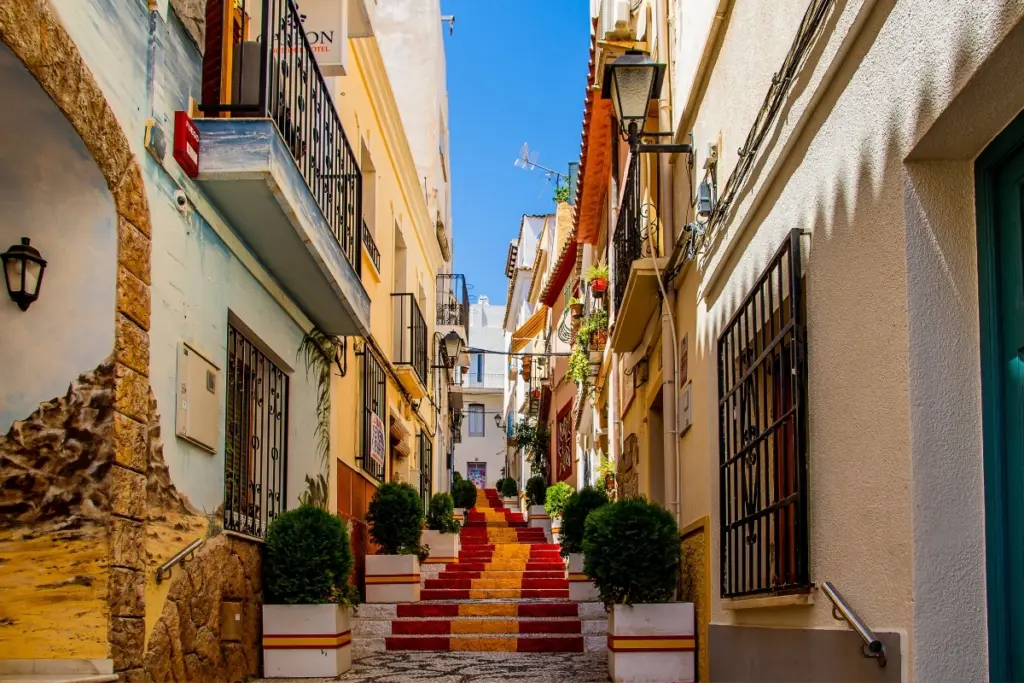
If you’ve scrolled through photos of Calpe, there’s a good chance you’ve already seen the Calpe Spanish Flag Steps without knowing it.
The staircase is painted in the red and yellow colours of the Spanish flag, with white planters, traditional street lamps and narrow buildings on either side.
They’re worth seeing when you’re already exploring central Calpe, but they’re a quick photo stop rather than a major attraction.
Where the Spanish Flag Steps Actually Are
Good news, the Calpe Spanish Flag Steps are simple to track down once you know exactly where to look: Carrer de Puchalt in Calpe’s old town. Search “Spanish Flag Steps Calpe” or “Carrer de Puchalt, Calpe” and either should get you there.
Some online guides use an address on Carrer de Pedro García Ortiz. That can take you close to the bottom of the staircase, but Carrer de Puchalt is the street you actually want. Use the named map pin rather than rely on a house number.
How Far the Steps Are From Arenal-Bol Beach
If you’re already at the beach, from the central part of Arenal-Bol, the walk takes around 10 to 15 minutes. The route heads inland towards the old town, with a slight climb during the final part. It’s easy enough for most people, though the staircase itself is steep and the surrounding streets aren’t completely flat.
From the marina or Peñón de Ifach area, allow closer to 30 minutes on foot. From La Fossa beach, only walk it if you already planned to spend time in the town centre. In summer a bus, taxi or short drive will usually make more sense.
What the Steps Actually Look Like
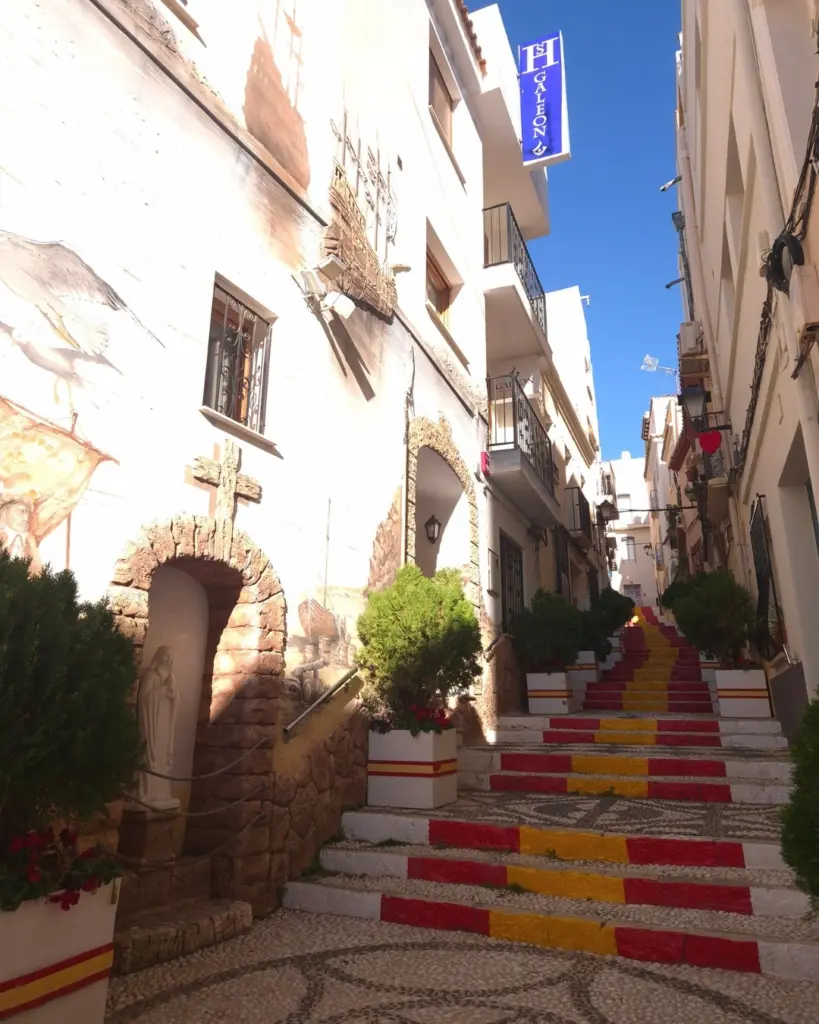
Picture a narrow street between traditional townhouses, with a staircase running straight up the middle of it. The centre is painted yellow, with red covering the surrounding steps to create the colours of the Spanish flag, and white planters and greenery line the sides, while balconies and street lamps complete the setting. I like the white flower pots along the edges especially, a nice touch that softens what would otherwise just be paint on concrete.
The best-known photograph is taken from the bottom looking upwards. That angle brings the red and yellow pattern together properly and makes the staircase appear longer than it does from the side or top.
The steps often look larger online than they do in person. They aren’t enormous, and there’s no viewpoint or separate attraction around them. They’re simply a brightly painted public staircase.
Are They Worth Visiting
I’ve been up Carrer de Puchalt many times over the years, usually just passing through on a wander round the old town, and my honest take hasn’t changed: they’re certainly worth a look, but they aren’t somewhere I’d make a special trip for. You look for a few minutes, take the photo, and move on.
The steps are colourful and easy to reach from the town centre, and they give you a clear reason to turn away from the beachfront and see another side of Calpe.
I wouldn’t plan a morning around them, though. Most people only need a few minutes to look at the staircase and take a few photographs. Plenty of others linger a lot longer than that, waiting for a clean shot with nobody else in it. The visit becomes more worthwhile when you continue through the surrounding streets afterwards.
The Best Time to Visit
Early morning gives you the best chance of finding the Calpe Spanish Flag Steps empty, and the old town is quieter before shops, cafés and visitors get moving. What it doesn’t give you is good light, the street is narrow enough that the sun hasn’t cleared the surrounding buildings yet, so the staircase sits in full shade rather than the bright, punchy colours you see in most photos. It’s a genuine trade-off: solitude over brightness. In July and August, before 09:30 gets you the empty steps, not necessarily the best photo.
Late afternoon works well, especially if you plan to stay in the old town for drinks or dinner. The light can be warmer, though the narrow buildings may cast shadows across parts of the staircase.
Midday is the weakest time during summer for comfort. The walk inland feels hotter than the seafront and there’s limited shade, but it’s also when the sun is high enough to actually light the steps properly, so there’s a real trade-off between comfort and getting the colours to show at their brightest.
How to Take a Better Photo
Here’s the trick every good photo of these steps uses: stand at the bottom and point the camera directly up the staircase. Keep the phone or camera as straight as possible so the buildings don’t lean too heavily into the image, and take one wider photograph showing the whole street plus one closer version with the planters and painted steps.
Carrer de Puchalt is still a residential street. People live there and use the staircase, so avoid blocking doorways, moving planters or holding up the route for several minutes.
How Long to Allow
The staircase itself takes around five to ten minutes. Allow 20 to 30 minutes if you want to walk up, take photographs and look around the nearby streets, and closer to 45 minutes or an hour when combining it with the main old-town landmarks.
Accessibility
The staircase isn’t suitable for wheelchairs or pushchairs, and the surrounding streets also include slopes, uneven paving and narrow sections.
With a pushchair, approach the lower end for the photograph and continue through the nearby streets rather than carry it up. Anyone with limited mobility may still be able to see the staircase from the bottom, but reaching the upper section will be difficult.
Parking Near the Spanish Flag Steps
There’s no dedicated car park for the Calpe Spanish Flag Steps. Don’t try to drive directly up Carrer de Puchalt. The old-town streets are narrow, and finding somewhere to turn or stop is more trouble than the final walk.
Park around the wider town centre and go there on foot. Parking becomes harder during summer evenings, fiestas and busy market days, so allow extra time.
What Else Is Nearby
The best part? Several of Calpe’s main old-town landmarks are just a short stroll away: Plaza de la Villa, Torreó de la Peça, Iglesia Antigua, Forat de la Mar and Carrer de Pescadors.
They’re close enough that you don’t need a rigid route. Wander through the narrow streets and return downhill towards the town centre or Arenal-Bol when you’re finished.
What to Know Before You Go
The steps are free to visit and form part of a public street, so there’s no gate or formal opening time. You can also visit in the evening. The old town is often more pleasant once the summer heat drops, though the colours may not photograph as clearly after dark.
The staircase can feel busy even with only a few groups because the street is narrow. If someone is already taking photographs, waiting a couple of minutes is usually enough.
Take care when the steps are wet. The surface is steep and uneven in places, so shoes with some grip are a better choice than smooth sandals.
There are no visitor facilities at the staircase itself. Toilets, cafés and places to buy drinks are found elsewhere in the old town and town centre.
Final Verdict
The Calpe Spanish Flag Steps live up to their photos, and the timings above hold up well, quick for the staircase alone, longer once you factor in the surrounding streets.
Take the photograph from the bottom, walk up Carrer de Puchalt and continue into the old town rather than turning straight back towards the beach.


